Varázskút
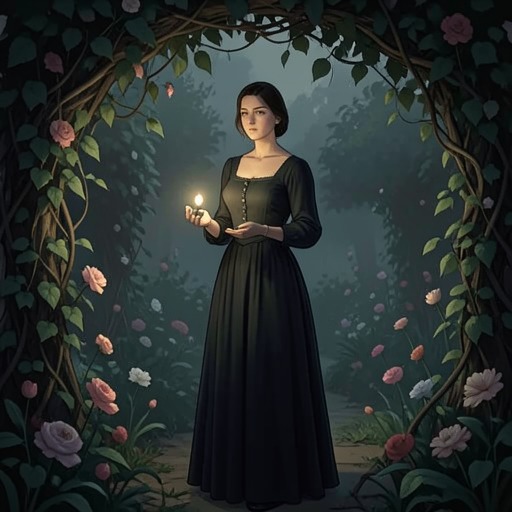
Csongor és TündeVarázskút is a prophetic well hidden in a cave beneath dense, leafy trees. Its reflective depths promise a glimpse of fate, but Mirígy controls access to it and shapes what others see. The well becomes a pivot between hope and deception: a place where the desire to know the future makes its visitors vulnerable to a false one.
Setting and Promise
The well stands before a cave shaded on every side by thick foliage. When Mirígy arrives, she uncovers it and identifies it as the well of the future, whose depths hold fate in their mirror. Its reflective surface offers more than a view of the present: it is presented as a means of seeing destiny turned inside out. That promise makes the well an apparent source of privileged knowledge, but the scene immediately places that knowledge under Mirígy’s control.
The setting gathers concealment around the act of looking. The leafy cover and cave frame the well as a secluded, enclosed space, while its mirror-like depth invites a visitor to lean toward an image and treat it as truth. The well’s power in the story therefore depends not only on what it shows, but on who arranges the encounter and what has been hidden before the viewer arrives.
Mirígy’s Staging
Mirígy uses the well as an instrument of deception. After preparing the danger of the prophecy, she declares that the visitor has arrived and that it is time to take her place. She covers the well with a black veil and hides in the cave. The covering is not incidental scenery: it marks the transition from an apparently available oracle to a concealed trap, while Mirígy’s retreat leaves the next visitor to encounter a scene she has arranged without seeing its maker.
The contrast between covering and uncovering recurs when Tünde finds the well open. She rejoices that it has no covering and that no veil of mourning hangs over it. Her relief shows that the well’s visible condition has acquired emotional meaning: an uncovered surface seems to promise access and safety, whereas the black veil signals grief and obstruction. Yet the earlier staging warns that openness alone cannot guarantee the truth of what appears there.
Visions and Consequences
Looking into the well, Tünde sees a landscape in which a young girl and a little lamb play in a green field. The image is pastoral and seemingly innocent, sharply unlike the cave’s fearful atmosphere. Its brightness draws attention to the well’s capacity to produce a world that feels complete in the moment of vision, even though the scene is mediated through a device that Mirígy has manipulated. The contrast makes the well a threshold between the darkness around it and an image that seems to offer reassurance.
The well’s danger becomes physical when a piece of cake is thrown into it. The object bursts into a great flame; Ilma runs away with a cry, and Mirígy rises from the well after the blaze. This sudden eruption overturns any assumption that the well is merely a passive reflecting surface. It connects the concealed depths to an active force, and the flame exposes the threat that the staged visions and prophecies have kept out of sight.
Prophecy and Narrative Role
The well’s prophetic promise directs Tünde toward an encounter she believes may disclose her fate. After hearing that she might obtain a prophecy by following a track, Csongor arrives at the place and recoils from its atmosphere, calling it a site of horror and mourning. He asks which way he should go to reach his beloved; a voice answers that he should follow what he is about to see. The well thus stands at the junction of desire and guidance: it seems capable of showing a path, but the surrounding deception makes the reliability of that guidance uncertain.
Its significance lies in the gap between seeing and knowing. The well offers images, predictions, and apparent direction, but these arrive within a space Mirígy has covered, uncovered, and used as a hiding place. The cave and the mirror-like depths turn the wish for certainty into exposure to manipulation. Rather than resolving separation, the oracle becomes one more mechanism through which the lovers’ search is redirected and made perilous.